Google just dropped some major Workspace and Gemini announcements at Cloud Next '26. They're building for a world where AI agents do real work inside your tools... autonomously, continuously, and across every team function.
As of this announcement in late April 2026, the question is not whether this is impressive. It is. The question is whether your organization is actually positioned to use any of it.
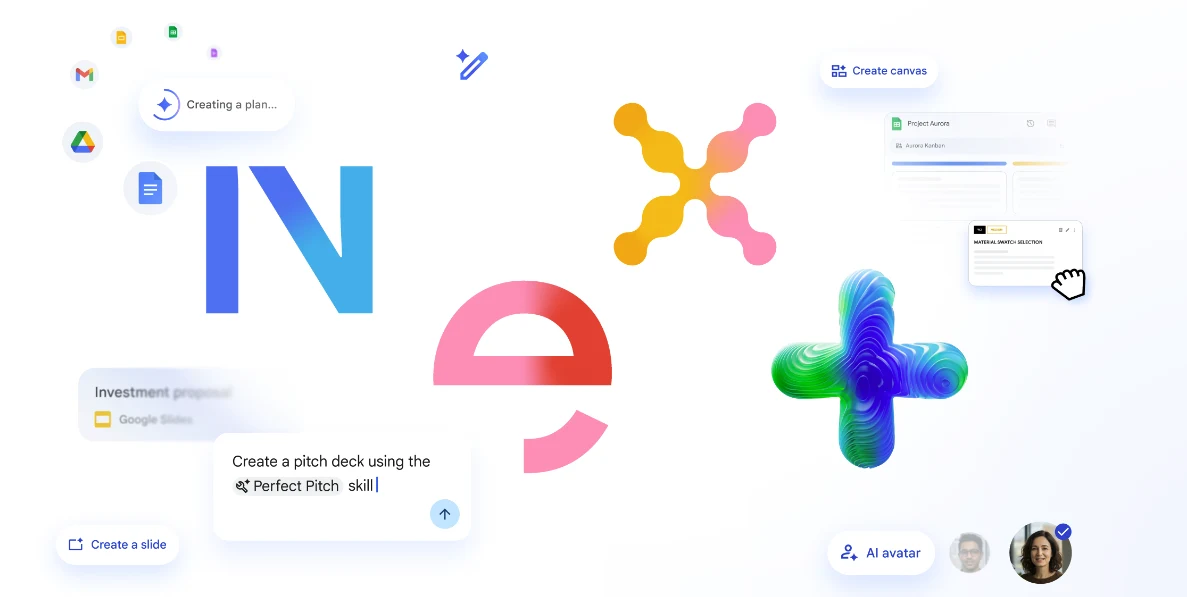
What Google Announced
Google's overarching move is something they're calling Workspace Intelligence ... a unified system that doesn't just pull from your data but claims to understand the semantic relationships between your documents, projects, collaborators, and organizational knowledge in real time. That's a significant architecture shift from "AI assistant" to "AI that understands your operating context."
Here are the announcements worth paying attention to:
Skills in Workspace. You can now build and deploy agentic automation across teams and workflows — directly inside Workspace — without writing code. Example: a skill that auto-reviews invoices by comparing new ones against historical records in your inbox, flags discrepancies, and reduces manual error-checking. Skills can be built and shared like a Google Doc. This is agentic process automation with a low barrier to entry... and that matters.
Gemini in Sheets: canvas + third-party data. Sheets is getting a fully interactive canvas layer — dashboards, heat maps, kanban boards — built on top of your data. And you can now pull data directly from HubSpot, Salesforce, and other platforms. This is Google moving closer to what Airtable and Notion have been doing, but with Gemini's analytical layer underneath it.
Google Meet: Take Notes For Me, everywhere. Over 110 million attendees used this feature in the last month alone, with 8.5x year-over-year growth. The expansion is significant: it now works for in-person meetings and on other platforms like Zoom and Teams. You tap "Take Notes for Me" on your phone, and Gemini captures a structured summary and action items to a Google Doc. No app switching. No missed context.
The Workspace MCP Server. Developers can now connect their AI applications and agents directly to Workspace... Drive documents, Gmail drafts, Calendar, Chat... through a standardized, secure framework. An official Workspace CLI is coming alongside it. This is Google's move to become the connective tissue in enterprise AI stacks, not just a productivity suite.
Agent governance controls. AI control center, agent management, and Workspace Studio controls give admins the ability to monitor, audit, and limit what agents can access. This is not optional infrastructure... it is the prerequisite for deploying any of the above responsibly.
Sovereign data controls + client-side encryption. Data processing and storage can now be locked to the US or EU, with Germany and India coming soon. Client-side encryption gives organizations the ability to deny access to their most sensitive data... including to Google. For regulated industries, this is meaningful.
The Honest Read
Google is building for organizations that are ready to take advantage of their Google Workspace ecosystem and Gemini integrations. While exciting and definitely some huge steps forward for those wanting to get more out of Gemini, this doesn't remove the current challenges that most organizations have in not being ready for AI implementations and transformation.
The Skills feature is a good example. On the surface, it sounds accessible: build automation without code, share it like a Doc, invoke it anywhere in Gemini. That's a low technical barrier. But the real barrier is not technical.
For Skills to work... your SOPs have to actually exist and be accurate. Your inbox and data storage have to be organized enough for an agent to parse. Your team has to understand what they're handing off to automation and what they're keeping. None of that is a technology problem. It's a people, process, and data foundation problem.
The same logic applies to Workspace Intelligence. A system that understands your organizational context is only as good as the context it has access to. If your projects are fragmented across tools, your team collaboration is ad hoc, and your data is inconsistent... Workspace Intelligence will understand chaos very efficiently.
The failure pattern here is predictable: organizations will activate these features because they are available, not because the foundation is ready. AI agents will surface bad data faster. Automated workflows will enforce broken processes at scale. And when it doesn't work, the conclusion will be "AI didn't deliver."
That's not an AI problem. That's a readiness problem.
What to Actually Do With This
If you are a Google Workspace shop, the right response to these announcements is not to activate everything immediately. It is to ask three questions:
1. Where are our actual documented SOPs, and are they accurate? If the answer is "we don't really have them" or "it's just in everyone's head," or even worse, "everyone just kind of does it their own way", that is your first constraint. Skills cannot automate a process that isn't clearly defined. Then the SOP must be very clear what the end goal is, and clearly explain what success looks like and how to evaluate the output of the work.
2. Is our data in a state where an agent can work with it? Gemini pulling from Drive, Gmail, and Sheets only helps if those sources are organized and trustworthy. Messy data plus autonomous execution is a compounding liability, not a productivity gain.
3. Who owns AI governance in our organization? Google is building governance tools... but they only function if someone is using them. Agent management and audit controls require a human owner with defined responsibilities. That role needs to exist before you turn agents loose.
The Bottom Line
Google's Cloud Next '26 announcements confirm the direction: AI-augmented work is becoming the default operating model, and the infrastructure to support it is getting better fast. This truly is exciting as I believe this unified ecosystem structure could really speed implementation and adoption in many organizations.
The organizations that will actually benefit are the ones that treat this as an operational readiness challenge, not a technology adoption challenge. Get the foundations right first. When they are, these tools will compound on each other in ways that create a real and durable advantage.
Nearly all organizations aren't there yet. The ones who start now... methodically, without skipping steps... will be.
Ryan Mull is an AI Transformation Coach and the founder of Magpie Solutions. He works with leaders who are serious about building AI-augmented operations that actually work... without the hype, without the shortcuts, and without leaving their people behind.