
Most leadership teams I talk with have already spent money on AI training. Licenses were purchased, a vendor ran a few workshops, and employees learned how to write prompts in whichever tool the company picked that quarter.
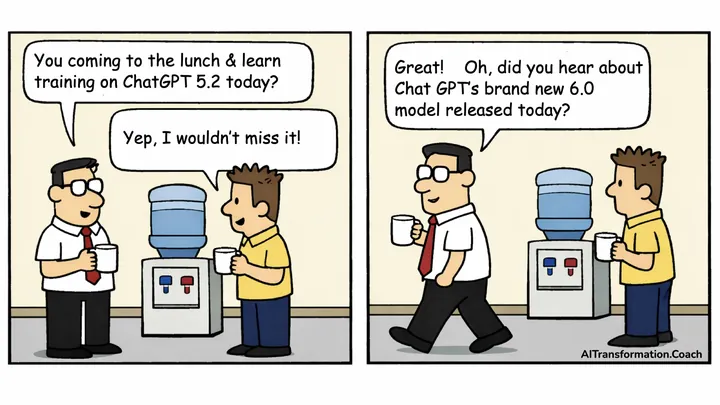
Then a few months passed. The tool shipped a new interface. Another model leapfrogged it. Half the features people were taught moved, changed names, or became automatic. And the leadership team is left asking a fair question… what did we actually get for that spend?
If that sounds familiar, you are not alone. Half of the American workforce now reports using AI at work, and yet in most organizations very little about how work actually gets done has changed. In most cases, the gap comes from what people were trained to do with the technology.
The Hidden Cost of Tool-First Training
Tool training is easy to buy and easy to measure. You can count attendees, completion rates, and logins. That visibility makes it attractive, especially when the board is asking what the company is doing about AI.
The problem shows up later, on a schedule you don't control. Every major model release or interface change resets part of what employees learned. So the organization pays again, and then again. I think of it as a retraining treadmill… the budget keeps moving, but the workforce doesn't get meaningfully further ahead.
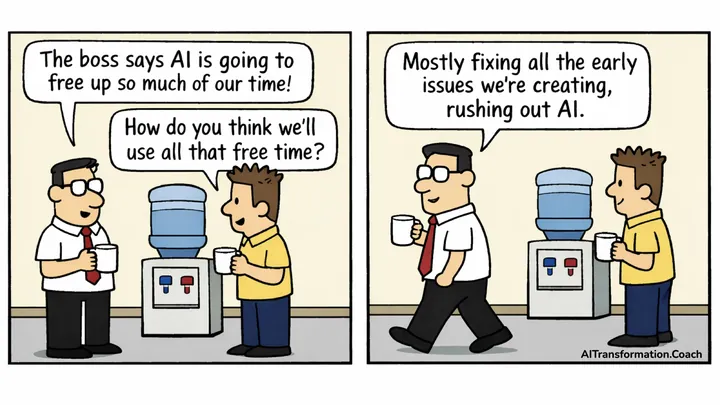
There's a second cost that rarely shows up in a budget review. When training stops at "here's how to use the tool," employees learn to produce more output, faster. They don't necessarily learn whether that output is right, whether it fits the business, or whether it should have been created at all. More volume without better judgment is a liability, and it compounds quietly.
I wrote about this earlier this year in a short piece on soon to be obsolete AI tool training. Since then, the pace of change has only picked up.
What Leaders Should Be Investing In Instead
The skills that hold their value are the human ones that sit underneath every tool. How people frame a problem. What context they give the AI. How they judge what comes back. How they stay accountable for the result. We call these durable AI skills because they keep working when the tools change, and they tend to become more valuable as AI gets more capable.
This belongs on the leadership agenda. The way your people work with AI will shape the quality of decisions, client work, and risk exposure across the company. Leaving it entirely to a software vendor's tutorial library means the tool's maker decides what your people learn.
If you want the deeper version, I've written a fuller explanation of what durable AI skills are and why they matter.
Tool training doesn't go away. People still need hands-on familiarity with the technology your company uses. What changes is the proportion. Tool familiarity becomes the smaller layer you refresh as needed. Durable skills become the foundation everything else is built on.
Five Questions to Ask Before You Approve Any AI Training Program
Before you sign off on the next training proposal, whether it comes from a vendor, a software provider, or your own team, ask these five questions.
- Will this still be useful if we switch AI tools next year? If the honest answer is no, you're buying a short shelf life.
- Does it teach people how to judge AI output, or only how to generate it? Generating is the easy part now.
- Is it tied to the real work our teams do every week? Generic examples rarely change habits. Training built around actual tasks does.
- How will the learning be reinforced after launch day? A one-day workshop fades fast. Short lessons spaced out over time are what stick.
- Who owns updating it as things change? If the answer is "nobody," the content will be outdated before most employees finish it.
If a program can't answer these clearly, that tells you something too.
What Changes When Your People Lead the Work
When employees build durable skills, their relationship with AI shifts. People stop treating the tool as an answer machine and start treating it as a capable collaborator that still needs direction, context, and review.
You'll notice it in small ways first. Better questions in meetings. Fewer AI-generated documents that look polished but miss the point. Managers spending less time cleaning up work that was produced fast and wrong.
Here's a simple example. A sales leader asks an employee to use AI to draft a proposal for a key account. An employee trained only on the tool gets a clean, confident document in under a minute and sends it. An employee with durable skills starts by giving the AI the client's real priorities, the history of the relationship, and what the company can realistically deliver. Then they read the draft critically, catch the two claims that don't hold up, and fix them before it goes out. Both used the same tool. Only one of them protected the account.
Speed still matters. But as I covered in The AI Speed Trap, moving fast in the wrong direction just gets you to the wrong place sooner. Teams with strong judgment can point AI's speed at the right work, and that's where the real productivity gains show up.
There's a people side to this as well. Many employees are quietly worried about what AI means for their jobs. Investing in skills that make them more capable, no matter which tools come and go, sends a clear message about how leadership sees them… as people worth developing. That matters for retention, and it matters for adoption. It's also why a technology-first approach to AI transformation is doomed from the start.
Where to Start This Quarter
You don't need a massive initiative to change direction. Three steps will get you moving.
- Take inventory of your current AI training spend. List what you've paid for in the last 12 months and mark which parts are tied to a specific tool or interface. Most leaders are surprised by the ratio.
- Define the work outcomes you actually care about. Faster proposals? Sharper analysis? Fewer errors in client deliverables? Measure training against outcomes like these, rather than course completions.
- Rebalance toward durable skills. Keep a light layer of tool familiarity, and make durable, people-first skill building the core of the plan. Then give people time to practice on real work.
AI tools will keep changing, probably faster than any of us expect. The organizations that come out ahead will have people who know how to think through a problem, direct the work, and evaluate the results, whatever tool happens to be in front of them.
If you'd like a second set of eyes on your current approach, schedule an intro call. And if you're ready to give your team skills that last, take a look at Durable AI Skills, the training program we built for exactly this.